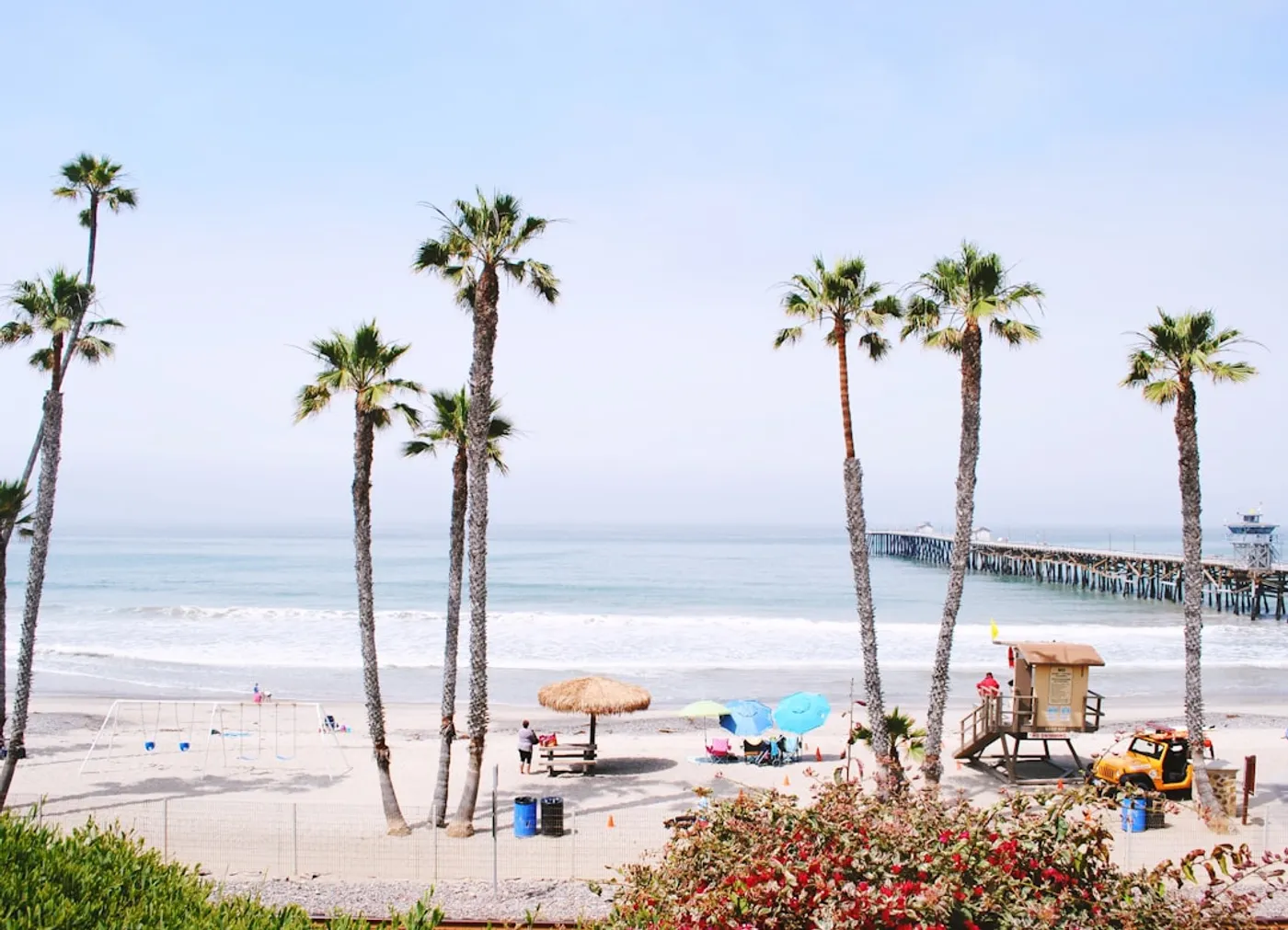
San Clemente — T-Street & Pier
San Clemente's Spanish-colonial beachfront — a world-class point break at T-Street, a classic wooden pier, and the only OC beach served directly by Amtrak.
Good to Know
- Admission
- Free
- Fees
- Free beach access; parking fee may apply at some lots
- Time to Allow
- 2–4 hours
- Parking
- Street parking along Avenida Del Mar; city beach lots near the pier
- Best Time
- Summer for warmest water; fall for clean south swells and emptier lineup
- Dogs
- ✗ Not allowed
Great for
San Clemente sits at the southern tip of Orange County, pressed between Camp Pendleton Marine Base and the Pacific, and the town’s insistence on keeping its scale small and its rooflines low has preserved a beach character that most of the county traded away in the 1960s. The Spanish-colonial architecture on the streets above the bluff, the tile-roof bungalows on the canyon sides, the coffee shops that fill early with surfers who drove down from L.A. for the weekend — it all reinforces the sense that San Clemente got away with something that Laguna and Newport didn’t quite manage to protect. T-Street and the pier area are the center of this identity.
T-Street — shorthand for the beach accessed from Trafalgar Street — is a right-hand point break that wraps around the base of the bluff and can hold shape through multiple connected sections on a solid south swell. The local surfers have strong claims on the lineup and the etiquette expectations that come with a quality point break; this is not a spot where dropping in on someone is overlooked. As a spectator location, though, T-Street is excellent: the blufftop trail above the break gives a clear sight line of the full wave from takeoff through the inside, and on a good day it’s some of the better free surf-watching in OC. The staircase down to the beach is at the south end of the bluff trail, a few minutes’ walk from the parking area on Calle Las Bolas.
The San Clemente Pier, about a 10-minute walk north along the beach from T-Street, is one of the oldest wooden piers on the California coast. Anglers fish its rails year-round; a casual restaurant at the end serves basic food and a straight view out to open ocean. At low tide the beach directly below the pier widens out and is consistently family-friendly — calm, sandy, with a lifeguard presence through summer. The combination of pier, beach, and town two blocks inland makes the pier area the most practical base for a first visit. Surf lessons and rentals are available from outfitters on Avenida Del Mar, which runs parallel to the coast through the beach town center.
The seawall trail connecting the pier to the beach neighborhoods runs for roughly two miles south, passing T-Street and continuing toward San Clemente State Beach. It’s flat, scenic, separated from car traffic, and free — one of the more underrated coastal walks in the county. The perspective from trail level is at water’s edge, lower than the blufftop paths in Laguna, and on a clear day the Channel Islands are visible offshore to the west. The trail provides the most direct route between the pier and T-Street without climbing back up to the street.
The Metrolink and Amtrak Pacific Surfliner stations sit directly on the beach at the north end of San Clemente — a genuine rarity in Orange County and one of the better rail-to-beach arrangements in Southern California. Trains run north to Irvine, Fullerton, and Los Angeles Union Station; south to Oceanside and eventually San Diego. Walking south from the platform to the pier takes about 10 minutes. Coming without a car is a genuine option here in a way it isn’t at most OC beach destinations, and the absence of parking logistics changes the whole day favorably.